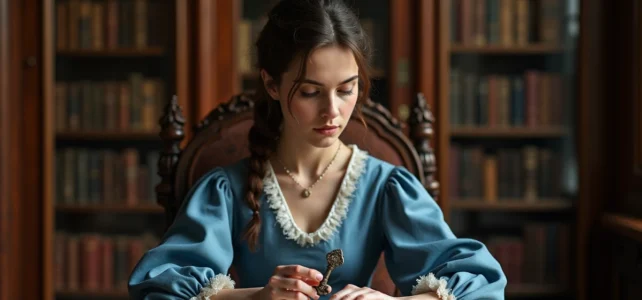
The first editions of Charles Perrault’s tales systematically included a moral in verse at the end of each story, a rare practice in the literature of the time. However, the moral of Bluebeard, far from being a simple warning for young girls, presents a paradox: it seems to endorse curiosity while condemning it. The reception of the tale has oscillated between edifying reading and subversive interpretation. This double discourse has continually fueled debates and reinterpretations, revealing the richness of the text and its lasting influence on literature for young people.
At the heart of Perrault’s tales: reworked tradition and modern boldness
When Bluebeard emerges from Perrault’s pen, it is not just a dark tale to disturb the nights. This story draws its roots from oral tradition, from old legends like The Badly Married Woman or echoes of Henry VIII, but it is the tension between heritage and modernity that strikes: the famous Quarrel of the Ancients and the Moderns runs through the work like an invisible thread.
You may also like : The Benefits of Reformer Pilates Classes
Perrault masters the art of balance: he breathes new life into the language, gives depth to the narrative, while skillfully handling well-known ancestral plots. Bluebeard then takes the form of a nightmarish figure, but also that of a mirror held up to the society of his time regarding the notion of disobedience and the thirst for knowledge. The infamous forbidden room, the center of the tale, encapsulates this ambivalence: both forbidden and alluring at once.
Behind the apparent terror, the analysis of the moral of Bluebeard opens the way to multiple readings. A cautionary tale, certainly, but also an invitation to question the place left for women, the power of secrets, the ongoing conflict between imposed discipline and the desire for freedom. Over the years, the work continues to disturb, to be adapted, to inspire critics and contemporary artists.
You may also like : Origin and meaning of the expression like father, like son
What the moral of Bluebeard really says about the era
Far from being reduced to a terrifying anecdote, the tale reveals the foundations of a society where male domination is exercised unabashedly. Perrault stages, almost clinically, the excessive power granted to Bluebeard and the vulnerability of his wife: surveillance, isolation, arbitrariness. The forbidden room becomes the symbolic boundary, an impossible taboo to circumvent without suffering humiliation or worse, violence.
Some details deserve to be clarified in order to grasp the power of the text:
- The presence of the bloodied key: it materializes control, showing that any disobedience cannot be concealed, no matter the cunning.
- The curiosity of the young wife, initially mocked, proves to be salvatory: it is she who sets in motion the ultimate resistance, with the help of her brothers.
Behind this mechanism, Perrault examines what gnaws at imposed marriages and the initiation into adult life for women at the time. There is hardly any talk of consent. The secret, central to the story, becomes the norm, and the fear of female rebellion remains omnipresent in the collective imagination. The moral suggests an ambiguous caution: on the surface, transgression is punished; looking closer, it is audacity that saves. Does surviving not sometimes mean daring to cross the imposed line?

Bluebeard, a matrix of endless inspirations and rewritings
Bluebeard, an unsettling figure that has become an archetype, retains a lasting influence. Medieval sources abound, as do comparisons with Henry VIII or Gilles de Rais, the latter especially feeding into the darker myth of the tale. But far from stopping at the page, Bluebeard spreads contagiously into popular culture.
Multiplying reinterpretations, creators seize upon it: Christian-Jaque adapted it for cinema as early as 1951, theater continually reinvents its key scenes, and critics do not fail to analyze the symbols of the locked room or the blood-stained key. The reflections of Bettelheim, Bremond, Tatar, Velay-Vallantin, or Lemirre return to it relentlessly. Amélie Nothomb, for her part, enjoys blurring the boundaries between fairy tale and modernity. In the collective imagination, it is the iconography of Épinal images that definitively imposes the silhouette of the character.
The motifs of the tale intertwine with other works. Specialists note surprising affinities: Sister Anne recalls the faithful Anna soror from the Aeneid, Bluebeard resembles the abandoned figure of Dido, the benevolent sister repeats from text to text. With each rereading, new paths emerge, doors crack open, and always this same unresolved question: what will the next version of Bluebeard look like? Perhaps, behind the next door, there are still many secrets to reveal.