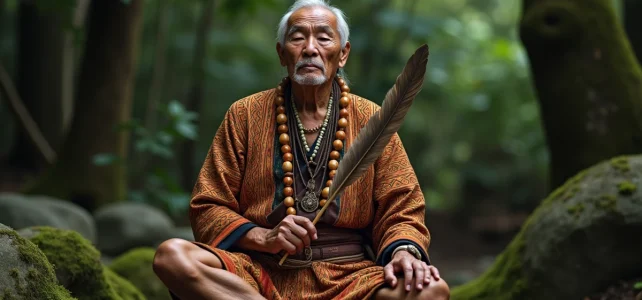
Traditional healers sometimes intervene in psychiatric disorders where conventional medicine lacks resources or recognition. Some ancestral rituals, long marginalized, are now attracting the interest of clinicians and social science researchers. At the intersection of spirituality and subjective experience, very different approaches to mental illness coexist, confront, or complement each other.
The dialogue between shamanic practices and contemporary psychology reveals unexpected convergences regarding the perception of symptoms, healing processes, and the role of the community in recovery.
The Origins of Shamanism: Diversity of Beliefs and Traditions Around the World
Shamanism knows no boundaries. Societies scattered across all continents have forged local variations, but the principle remains: the shaman stands at the junction of the visible and the invisible, capable of communicating with the spirits of nature, animals, and ancestors. Whether in the Siberian steppes, the vast North American plains, Tibet, or the Amazons, each tradition adapts its rituals to the culture but shares the same idea: illness, whether physical or mental, arises from an imbalance in the spirit world.
Visions of shamanism manifest as a mosaic of rituals and symbols. Here’s how this diversity is expressed across regions:
- In Mongolia, Mongolian shamanism is based on ancestor worship and the invocation of auxiliary spirits.
- In China, shamanic practices often intertwine with Taoist traditions.
- In Central Asia, the axis of the world connects heaven, earth, and the underworld, structuring the relationship to the sacred.
Researchers like Mircea Eliade and Michael Harner have shown that the shaman, everywhere, is distinguished by this ability to travel between worlds. They act as mediators when disturbances attributed to the loss of a soul, possession, or attack by malevolent spirits occur. When comparing shamanism to mental illness, one discovers an expanded conception of health: healing encompasses body, mind, social ties, and the relationship to the invisible.
Rituals, Symbols, and Experiences: How Shamanism Approaches Mental Illness
The shaman’s approach to psychic disorders sharply contrasts with Western medicine. For them, mental suffering reflects a rupture between body, mind, and environment, often caused by the loss of a part of oneself or the intrusion of a foreign spirit. Rather than medicalizing the symptom, the shaman engages a response where trance and altered states of consciousness play a central role.
Several major axes can be distinguished in how shamanic rituals address mental illness:
- Shamanic journey: the shaman enters trance through rhythms, chants, or specific plants to explore the spirit world and seek the cause of the imbalance.
- Healing rituals: purification by smoke, calling on auxiliary spirits, and restoring the lost soul: these practices aim to restore the link between the individual and the community.
- Symbols and ritual objects: drums, feathers, or stones, each with a specific function, serve as supports to cross the boundaries between worlds and facilitate mediation.
Altered states of consciousness are not mere curiosities: they form the core of the shamanic experience. Trance offers the shaman the opportunity to traverse different planes of reality, investigate the invisible causes of suffering, and orchestrate a healing that engages both mind and body. Anthropologists, such as Sandra Ingerman, describe these practices as a true therapeutic intelligence, where the understanding of metaphysical truths guides every gesture. What is also striking is the collective dimension of shamanic rituals: they create a space for expression and recognition, often absent from purely Western medical approaches.

Shamanism and Modern Psychotherapy: What Bridges to Understand the Human Mind?
Upon closer examination, the lines of division between shamanic consciousness and contemporary psychotherapy are not so clear. When it comes to understanding mental illness, similarities emerge. Shamanism refuses to separate body and mind: it offers a holistic approach, where the ritual places the symptom within a shared story with the community. In contrast, modern psychotherapies prioritize introspection, verbal expression, and individual analysis. However, shamanism speaks of imbalance between multiple planes of reality, not just a personal disorder.
The way of approaching “extraordinary” states varies across cultures. In France, the clinic categorizes symptoms. In Venezuela, possession cults integrate altered states of consciousness into social life. The idea of healing then takes on a particular dimension: whether shaman or therapist, the practitioner becomes a bridge, a mediator between worlds, between languages, between experiences.
By connecting traditional shamanism and the tools of psychotherapy, we question the very notion of spirit. Recent research focuses on the technique of ecstasy, the role of ritual, or the importance of creating spaces for shared dialogue. Understanding shamanism requires revisiting our definitions of symptom, pathology, and healing. Bridges exist, not in copying, but in recognizing what makes each path unique.
As boundaries fade, one question remains: how far are we willing to challenge our certainties about madness, suffering, and what healing truly means?