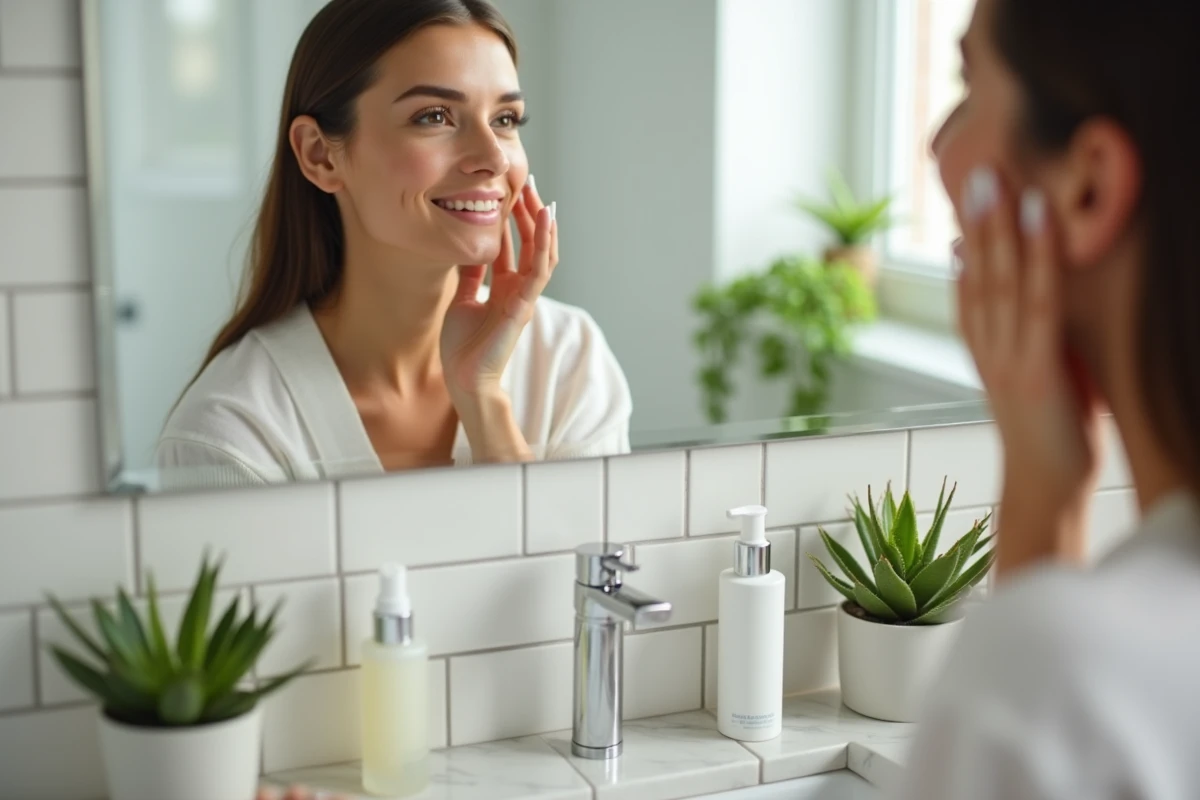
Enhancing your beauty on a daily basis is not just about piling products on your face every morning. Recent data on cosmetics shows a clear shift: consumers are reducing the number of steps in their beauty routine and favoring versatile products. At the same time, health alerts regarding certain ingredients require a different approach to reading labels. What do we really measure when we talk about an effective routine, and what criteria distinguish a useful action from a superfluous one?
Minimalist beauty routine vs. multi-step routine: what consumer trends reveal
The Cosmetics Observatory and market panels document a strong rise in minimalist routines, known as skinimalism. Consumers are abandoning seven or eight-step protocols to focus on a few versatile products: a gentle cleanser, a moisturizer, and sun protection.
This simplification is not just a passing trend. It is accompanied by a decline in sales of complex niche products and an increase in hybrid creams that combine care, protection, and tone correction.
| Criterion | Multi-step routine | Minimalist routine |
|---|---|---|
| Number of face products | 6 to 10 | 2 to 4 |
| Average time in the morning | More than 15 minutes | Less than 5 minutes |
| Type of preferred products | Targeted serums, essences, masks | Hybrid creams, gentle cleansers |
| Risk of interactions between actives | Higher | Reduced |
| Market trend | Declining | Increasing |
The table shows a gap in philosophy, not just in quantity. Multiplying facial care increases the risk of mixing incompatible actives (exfoliating acids and retinol on the same night, for example). Reducing the number of products mechanically limits this risk while simplifying the daily beauty routine.
Resources like Secret de Beauté help identify products that combine multiple functions without sacrificing the effectiveness of each action.
Endocrine disruptors in cosmetics: reading the ingredient list beyond the organic label
For several years, ANSES and the European Commission have intensified alerts regarding endocrine disruptors present in cosmetic products. Chemical UV filters, certain plasticizers, controversial preservatives: these substances can be found in both conventional products and those labeled “natural.”
The organic label does not guarantee the absence of these compounds. Some sunscreen filters allowed in organic cosmetics are the subject of scientific discussions. Reading the INCI list (International Nomenclature of Cosmetic Ingredients) remains the most reliable action to identify what a product actually contains.
- Check for the presence of suspected UV filters (certain benzophenones, for example) rather than relying solely on the logo on the packaging
- Favor products with a short and readable ingredient list, a sign of a formulation less loaded with additives
- Consult public databases for cosmetic ingredient evaluations to cross-reference information
This vigilance regarding the composition of beauty products changes the way we shop. It shifts the choice criterion from marketing to actual formulation, aligning with the minimalist approach: fewer products, but better selected.
Personal beauty signature: building your rituals instead of copying a standard routine
Standard beauty advice often proposes a single scheme: cleansing, toning, serum, cream, sun protection. This protocol suits certain skin types, but it does not take individual constraints into account (climate, lifestyle, skin sensitivities).
Defining your own beauty signature involves identifying the two or three actions that produce a visible result on your skin, then sticking to them. For some, evening cleansing and a moisturizer are sufficient. For others, an eye cream makes a measurable difference.
Three questions to identify your priority actions
- What is the first visible sign when the skin is neglected (tightness, excessive shine, redness)? This sign guides the choice of the main product
- What action brings a noticeable change in less than a week? That one deserves to be kept, while others can be reassessed
- Does the current routine take more time than the benefit it provides? If so, it’s time to simplify
This approach produces a beauty routine that reflects the real needs of the face and body, not an ideal promoted by a brand or social media. A ritual suited to your skin is better than a protocol copied from a tutorial.

Eye makeup and ocular health: a trade-off often overlooked
Dermatologist and ophthalmologist associations, including the French Society of Ophthalmology, warn about ocular irritation and dryness related to eyelash extensions, glues, and long-lasting makeup. These products, worn daily, weaken the periocular area.
The simplest recommendation is to incorporate makeup-free days for the eyes into the week. This is not an aesthetic renunciation; it is a preservation choice. Wearing eyeshadow five days a week instead of seven produces a comparable result while allowing the mucosa to recover.
Makeup removal is just as important as the makeup itself. An overly aggressive cleanser on the eye area ultimately causes more damage than the makeup it removes. A gentle makeup remover, used without rubbing, protects the delicate skin of the eyelids and preserves the tear film.
By cross-referencing consumption data and medical recommendations, one conclusion emerges: daily beauty is more about the rigorous selection of a few actions than the accumulation of products. Reducing, reading labels, adapting your routine to your own skin – these three axes concentrate the essence of what distinguishes effective care from a superfluous habit.